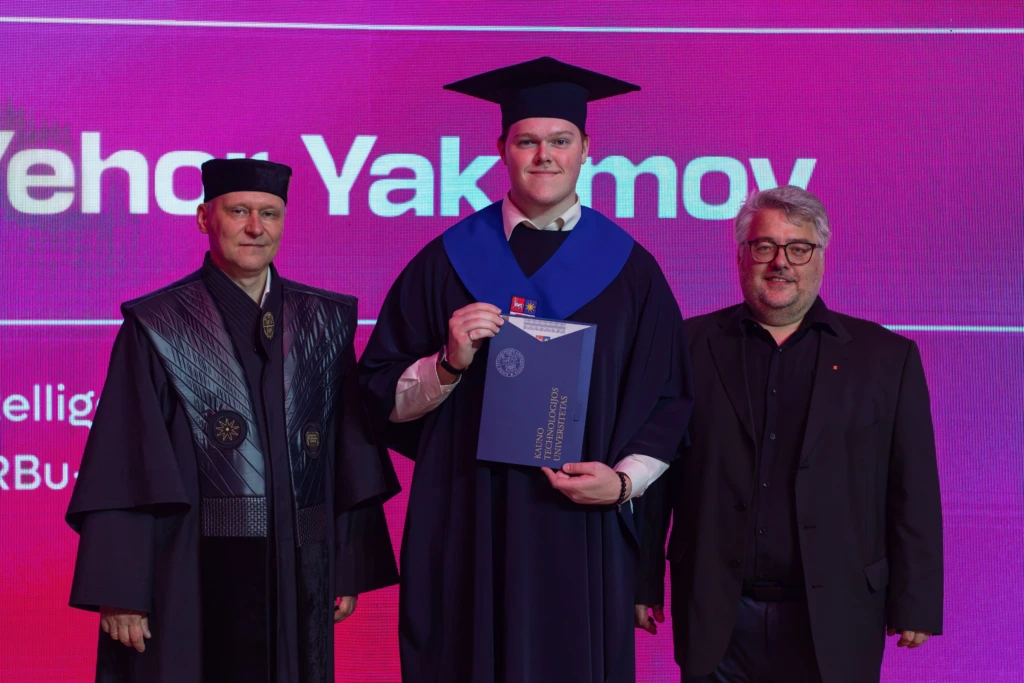



“For the past year and a half, I’ve been doing projects related to cancerous issues, and this is like a culmination,” says Ukrainian Yehor Yakymov. He graduated from KTU with a bachelor’s in Robotics this June. Inspired by his family’s health journey, Yehor developed a new skin analysis algorithm to detect early melanoma. He successfully presented his project at the annual innovation exhibition Technorama 2026 during his final year of studies.
“My mother had cancer – it was a melanoma, breast cancer and more. So, it was always something I was aware of since a young age. It’s been a very long journey, and thank God everything is fine now, but it definitely gave me a lot of inspiration,” Yehor shares, explaining the deep personal drive behind his project.
Translating Medical Methodology into AI Code
The project goal was to develop a tool to extract features from medical skin images.
“This is a feature extraction algorithm of malignant skin lesions, mainly melanoma. It is based on medical data on how it is really done. It is based on the ABCD method, which basically measures the asymmetry, border regularity, colour variation, and diameter of the lesion,” Yehor explains. “Based on these four parameters, the score is calculated to see if the lesion is benign, suspicious, or malignant.”
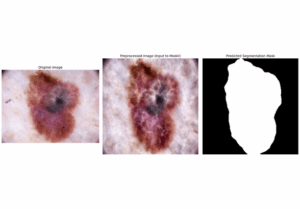
To achieve this, Yehor selected a real-world medical method and implemented it through programming. First, he built a strong preprocessing step to clean all artifacts and noise from the skin images. Next, he trained a special artificial intelligence model called Attention U-Net. He tested multiple setups to find the best architecture for making image masks. Finally, his system uses these masks within a custom ABCD framework to calculate the Total Dermoscopic Score.
The long-term vision of this algorithm lies in its potential for mobile integration and remote screening. “In the future, it’s possible to apply it to telecommunication easily. You could take a picture, and if you knew your dimensions and everything, you could run it through and have a preliminary check. It could tell you: is this something you should be aware of? Should you go and look into it further?”